Global Markets — Week of 9–13 November 2026
Volumes confirmed, prices whipsawed: record TSMC revenue and power-equipment orders met a CEO shock at Nvidia and the fastest producer-price rise since 2022
A rebound week that ended on a warning: Every major index except Hong Kong and Shanghai rose in the week of 9–13 November, led by Taiwan (+10.0%) and Japan (+6.5%), as earnings confirmed AI data-centre demand in volume terms — record TSMC monthly revenue, record Hon Hai profit, record Applied Materials and Cisco revenue, record Siemens and Japan machine-tool orders. Prices, however, were set by two shocks: Nvidia's founder-CEO resigned mid-week (shares −12.75% on the week) and US producer prices rose +6.5% year on year (前年比), the fastest since November 2022, pushing the US 10-year yield up 29bp to 5.15% and unwinding the semiconductor rotation on Friday.
Key points
- Demand was confirmed in volumes, everywhere. TSMC October revenue was a record NT$586.89bn (+59.7% YoY); Hon Hai Q3 net profit was a record NT$77.5bn (+34%) with AI servers at 54% of sales; Applied Materials Q4 revenue was a record $10.41bn (+53%); Cisco Q1 revenue was a record $18.5bn (+24%) with FY27 guidance raised; SMIC utilisation reached 97.3% on record revenue of $3.19bn.
- Nvidia was the week's price event — governance, not demand. Jensen Huang resigned as President, CEO and director with immediate effect (announced 12 Nov); CFO Colette Kress is interim CEO. The shares opened −13.1% on 12 Nov, recovered to close −4.34%, and ended the week at $162.85, −12.75% week on week and below a $4tn market cap. Interim management is also reviewing Huang-era financing commitments (the OpenAI Ohio support was reportedly cut from $250bn to $120bn).
- Power and machinery breadth was the second story. Siemens Q4 orders rose 58% to a record €34.77bn; Hitachi Energy India's orders rose 85.9% with a record backlog of ₹333.35bn and data centres its No. 2 order source; GE Vernova won 765 kV orders (70+ units) from POWERGRID; India approved its first 1,150 kV project (₹68,816 crore); Japan machine-tool orders hit an annual record in ten months (October ¥204.4bn, +42.5% YoY).
- Macro pushed the other way — and won on Friday. US October CPI was hot (+0.4% MoM vs +0.3% consensus) and PPI rose +6.5% YoY. The US 10-year yield closed at 5.15% (+29bp on the week, its largest weekly rise since April 2025); USD/JPY touched 160.03 and the 10-year JGB yield rose to 2.86%. Friday's US close unwound the rotation: SOX −3.4%, AMD −8.8%, Nvidia −2.0% — yet the SOX still gained +8.05% on the week and all 11 S&P 500 sectors finished higher.
- Capex is still rising; the constraint is delivery and funding cost. Nebius raised 2026 capex guidance to about $27bn (2027: $40–45bn guided) while some third-party capacity slipped into H1 2027; CoreWeave's backlog reached $132.5bn against $846M of quarterly interest expense; Anthropic's Q3 compute spend was $9.9bn, 58% of revenue; Samsung pulled its HBM packaging plant forward a year to June 2028; China's domestic AI accelerators' combined share passed Nvidia's for the first time (Huawei Ascend 28%).
| Tracker | This week | Reference |
|---|---|---|
| TSMC monthly revenue | NT$586.89bn, +59.7% YoY | Oct 2026, monthly record |
| JP machine-tool orders | ¥204.4bn, +42.5% YoY | Oct 2026, annual record in 10 months |
| Hitachi Energy India orders | +85.9% YoY; backlog ₹333.35bn | Q2 FY27, backlog a record |
| Nebius 2026 capex guide | Raised to about $27bn | From $20–25bn, 12 Nov |
| CoreWeave backlog | $132.5bn | From $104.2bn at Q2 end |
| SMIC utilisation | 97.3%; revenue $3.19bn | Q3 2026, revenue a record |
| US PPI | +0.3% MoM; +6.5% YoY | Oct 2026, YoY largest since Nov 2022 |
| NVDA share price | Week −12.75%; close $162.85 | 13 Nov close; prior Fri $186.64 |
Company results and official statistics as cited in the daily packets, 10–14 Nov 2026.
Part 1 — Market performance
1. Week in numbers — bought: chips ex-Nvidia, Taiwan, Japan, power. Sold: Hong Kong, gold, duration
Weekly moves, Friday 6 November to Friday 13 November closes (Figure 2). Japan led the developed markets: the Nikkei 225 rose +6.46% to 61,142.35 (+3,707.58 points; its best week in five months) and TOPIX rose +6.30% to 3,941.57 (its best since August 2024) — a rebound from the prior week's rout (Nikkei −9.3% in the week to 6 Nov). Taiwan's TAIEX rose +10.01% (+3,973.48 points to 43,675.12), ending four weekly declines, and Korea's KOSPI rose +4.56% to 5,290.53. In the US, the S&P 500 gained +2.51% to 7,561.67 (best week since early August, snapping a four-week losing streak), the Nasdaq Composite +2.27% to 25,136.27, the Dow +2.07% to 52,347.55, and the Philadelphia Semiconductor Index (SOX) +8.05% to 10,146.32 despite Friday's −3.4%. Europe's Euro Stoxx 50 rose +3.19%. The losers were Hong Kong (Hang Seng −3.45%) and Shanghai (−0.41%): the regional split was a China split, not an Asia split.
Rates and FX moved against equities all week. The US 10-year Treasury yield closed at 5.152% (+29bp on the week; intraday high 5.17%), the 2-year at about 4.89% (+36bp), as markets priced a possible December Fed hike after hot CPI and PPI prints. USD/JPY closed near 159.7–159.9, having touched 160.03 intraday on Friday — the first breach of 160 since early September — drawing a one-sided-moves warning from Finance Minister Katayama; the dollar index rose about +1.1%. The 10-year JGB yield rose to 2.86% on Friday (+7bp on the day), its highest since 22 October. Commodities: WTI settled at $88.56 (−2.50% on the week) and Brent at $95.84 (−2.52%), a second straight weekly decline as the IEA pointed to a Q4 supply surplus; gold fell about −4.6% to roughly $3,886/oz, its biggest weekly drop in about four months.
What was bought and what was sold (sector rotation, 回転): bought — semiconductors ex-Nvidia (the SOX +8.05% with Nvidia −12.75% means the rest of the index did the work; AMD rose roughly +30% intraw-week before Friday's −8.8%), Taiwan and Japan beta, power equipment and grid names in India (Hitachi Energy India +12% on Friday), and, in the US, breadth itself (all 11 S&P 500 sectors positive on the week; more than 60% of S&P 500 stocks rose even on Friday). Sold — Nvidia specifically, Hong Kong/China exposure, gold and long duration (債券のデュレーション), and on Friday the week's rotation winners (AMD −8.8%, Broadcom −4.8%, Cisco −6.24% despite a beat-and-raise). The pattern is positioning, not fundamentals: the same names were bought on prints early in the week and sold on the discount rate (割引率) by Friday.
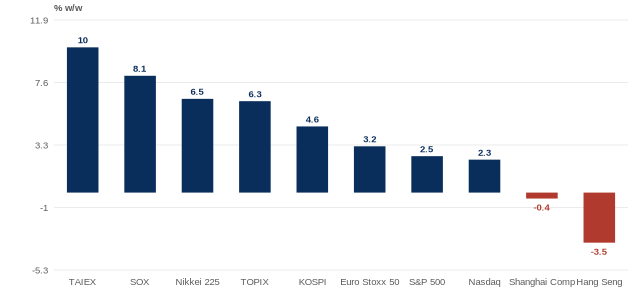
Exchange closes, Fri 6 Nov to Fri 13 Nov 2026: Reuters / Dow Jones Market Data via Morningstar (Japan); AP and CNBC (US); CNA (Taiwan); closes computed from Naver Finance levels (Korea); weekly reviews (Europe, Hong Kong).
2. Market performance pack — sectors and coverage movers
Using the TradingView sector/industry taxonomy as the reference framework: at index level the week's ranking was TAIEX +10.01% > SOX +8.05% > Nikkei +6.46% > TOPIX +6.30% > KOSPI +4.56% > Euro Stoxx 50 +3.19% > S&P 500 +2.51% > Nasdaq +2.27% > Shanghai −0.41% > Hang Seng −3.45% (Figure 2). A full weekly sector matrix by country from TradingView is 未取得 for this edition; the latest-session Japan industry snapshot (Figure 4) shows the tape beneath Friday's flat Tokyo close — electrical products −4.05%, communications equipment −2.36%, electronic components −1.66%, semiconductors −1.06%, against computer hardware +1.68% — i.e. Friday's selling in Japan was also concentrated in the AI complex. In the US on Friday, technology was the worst S&P 500 sector (−1.7%) while the equal-weight index rose, confirming concentration.
Coverage watchlist movers, each tied to its catalyst in Part 3: top — Hitachi Energy India +12% (13 Nov, print + 1,150 kV approval); CoreWeave +24.71% (11 Nov, Q3 beat); the SOX ex-Nvidia complex mid-week (SOX +5.66% on 11 Nov with all 30 constituents up). Bottom — Nvidia −12.75% on the week (CEO resignation); Nebius −16.84% on 12 Nov (capex raise plus capacity slippage, despite a revenue beat); ams OSRAM −9.2% on Friday (Q4 guidance below consensus); SoftBank Group −5.11% on 13 Nov in Tokyo (follow-through from its H1 loss on the US AIDC power-procurement write-down); Cisco −6.24% on Friday despite record results — the clearest sign that by Friday the discount rate, not the print, was setting prices.
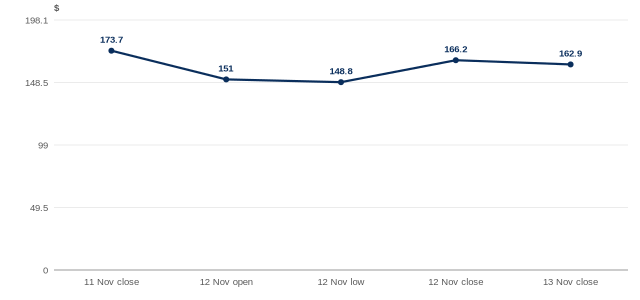
Finnhub market data via the daily packets, 12–13 Nov 2026; weekly close data via Longbridge.
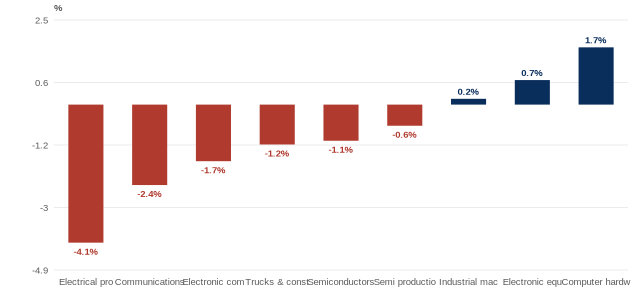
TradingView Japan sector/industry table, retrieved 15 Nov 2026 (latest session). Daily, not weekly, moves.
Part 2 — Coverage recap
3a. Semiconductors and AIDC — record volumes, a governance shock, rising capex
Semiconductors. TSMC's October revenue of NT$586.89bn (+59.7% YoY, +14.7% MoM) was its largest month on record (previous record: August, NT$514.81bn); January–October revenue reached NT$4,485.62bn (+43.3%). Its board also approved appropriations of $40.93bn and up to $500M each of investment linked to Anthropic and OpenAI (noon packet, 11 Nov). Applied Materials posted record Q4 revenue of $10.41bn (+53% YoY), adjusted EPS of $4.16 vs $4.06 consensus, and Q1 FY27 guidance of $11.1bn ± $0.5bn vs $10.89bn consensus; management guided to 2027 wafer-fab equipment (WFE) demand growth of more than +30%. SMIC's Q3 revenue was a record $3.19bn (+33.9% YoY) with utilisation of 97.3% and gross margin of 29.9% vs 26–28% guidance; Q4 guidance is revenue +4–6% QoQ. GlobalFoundries' Q3 gross margin was a record 31.4% (+540bp YoY) on revenue of $1.899bn, with communications infrastructure & data centre revenue +81% YoY; its 2026 silicon-photonics revenue outlook was raised to $500M, and it broke ground on the first Malta fab under the US–Japan initiative (up to $21bn of Japanese funding; first fab about $10bn, 2029 start, roughly 900k 300mm wafers a year). In Japan, Micronics Japan's nine-month operating profit rose +138.9% YoY to ¥26.99bn with the FY operating-profit guide raised to ¥36.1bn and the dividend lifted to ¥208; Eblen's H1 operating profit rose +106.2% to ¥490m on HBM-related demand, with FY guides raised sharply — the HBM investment chain is reaching probe cards and measurement/control equipment. The counter-example was SUMCO: nine-month sales +9.2% to ¥332.5bn but an operating loss of ¥4.40bn — volume without price. Resonac raised its FY core operating-profit guide to ¥250bn (from ¥196bn) on semiconductor materials, while selling its graphite-electrode business to Aurelius and booking a roughly ¥105bn non-recurring loss — portfolio concentration on chip materials, at a stated price. Nippon Steel Chemical & Material guided AI-server substrate resin volumes +80% and bonding-wire volumes +15% for FY2026.
AIDC. CoreWeave's Q3 revenue was $3.661bn (+168% YoY vs $3.54bn consensus), backlog $132.5bn (from $104.2bn at Q2-end), adjusted EBITDA margin 62%, active power above 1.7GW — against a net loss of $709M and interest expense of $846M; FY26 revenue guidance was raised to $13.0–13.3bn. Nebius' Q3 revenue was $980.8M (+571% YoY vs $907.5M consensus), but about $325M was asset-light partner revenue of a temporary nature, some third-party capacity slipped into H1 2027, the $7–9bn ARR target moved from December to February 2027, and 2026 capex guidance rose to about $27bn (from $20–25bn), with an initial 2027 view of $40–45bn capex on $12–13bn revenue. Hon Hai's Q3 net profit was a record NT$77.52bn (+34% YoY vs NT$69.6bn consensus) on revenue of NT$3.02tn (+46%), with cloud & networking (AI servers) at 54% of sales and gross margin of 6.02%; Pegatron's October revenue rose +59.6% YoY to NT$188.08bn and Wistron's Q3 net profit rose +149% (held item, noon packet 12 Nov). Cisco's record Q1 revenue of $18.5bn (+24%) and FY27 guide raise (to $74.8–75.8bn, with hyperscaler AI-infrastructure revenue seen at about $9bn, more than double FY26) show capex broadening from GPUs to networking. Cerebras posted record core revenue of $230.9M (+70%), a first adjusted net profit of about $30M, 700MW of contracted capacity and RPO (remaining performance obligations, 残存履行義務) of $26.1bn, with Microsoft its third hyperscaler customer. Anthropic's amended S-1 showed Q3 revenue of $16.96bn with compute/infrastructure spend of $9.9bn (58% of revenue, up from 48% in Q2) and purchase/lease commitments of about $895.4bn. Naver disclosed a roughly ₩2tn, five-year, ~20MW inference-compute contract and an AI-factory ramp of 55MW (H1 2027) → 100MW (end-2027) → 200MW (2028), with secured capacity already above its 2028 disclosure target. SoftBank Group's H1 net loss of ¥768.0bn (vs a ¥2,924.1bn profit a year earlier) was driven by a ¥597.2bn loss on revising US AIDC power-equipment procurement and ¥270.1bn of Intel/derivative losses — execution risk in the AIDC build-out, in print. Weekend follow-ups (15 Nov packets): Digital Realty plans a further $10bn of investment in Japanese data centres; TI Korea flagged the AI bottleneck spreading to mature-node power and embedded chips; Atlanta Electricals reported new transformer orders.
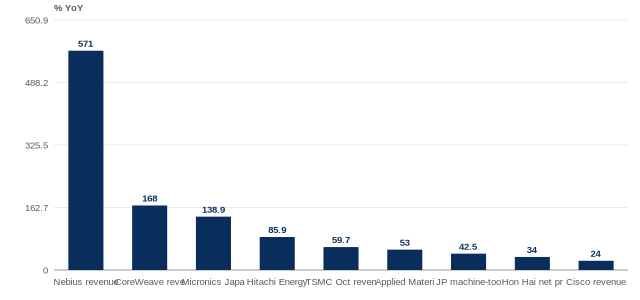
Company results, 10–14 Nov 2026. Each bar is the metric named in its label; metrics differ by company and are not directly comparable.
3b. Power, cooling, machinery, components and humanoids
Power. Siemens' Q4 industrial profit was a record €3.89bn (+22% vs €3.71bn company consensus) on revenue of €23.68bn (+11%) and record orders of €34.77bn (+58%), led by mobility and smart infrastructure including data-centre electrical equipment; its medium-term revenue growth target was raised from 6–9% to 7–11%. Hitachi Energy India's Q2 (Jul–Sep) revenue rose +63.6% to ₹2,996.5 crore with orders of ₹4,120.8 crore (+85.9%) — grid transmission (transformers, STATCOM, cooling, AIS/GIS) led, data centres were the No. 2 order source, exports rose +41% in the quarter (+184% in H1) — and backlog reached a record ₹33,335.4 crore, about 11.1x one quarter's revenue. GE Vernova won POWERGRID orders for 70+ 765 kV transformers and shunt reactors (deliveries 2026 to end-2027; value undisclosed, 未取得). India's National Committee on Transmission approved the country's first 1,150 kV project (Raigarh–Kotra–Rourkela–Kolaghat; ₹68,816 crore, about six years, for 12GW of renewables plus storage) — Hitachi Energy is India's only type-tested 1,150 kV transformer maker, per Equirus via the Economic Times. CG Power won a ₹9bn order to supply transformers from India for a US hyperscale data centre (12–20 months execution). Korea's Honam chip cluster added transformer orders with 4GW planned by 2029. On the theme layer: Infineon will supply the first 900V GaN bidirectional switch to Enphase for its IQ solid-state transformer (固態変圧器) for AI data centres — device testing complete, integration under way, qualification to follow — direct evidence for the solid-state-transformer and GaN themes in this report's coverage. Cooling: Samsung Electronics was reported (CLS, 13 Nov) to be in talks to acquire Modine Manufacturing (market cap about $5.6bn; shares down about 15% since its 3 Nov print) — a possible deal within weeks, with Daikin, LG Electronics and Vertiv also investing in the same bottleneck.
Machinery, FA and components. Japan's October machine-tool orders were ¥204.4bn (+42.5% YoY; domestic ¥52.3bn, +46.5%; foreign ¥152.1bn, +41.1%), the second-highest month on record, taking January–October orders to ¥1,873.7bn — above the 2018 full-year record of ¥1,815.8bn with two months to spare; order backlog at end-September was ¥1,098.2bn. JMTBA's chairman named AI/data centres, semiconductor equipment, energy and aerospace as the drivers — explicitly not autos, unlike 2018. Daifuku raised FY guides (sales ¥770bn, operating profit ¥119bn) and its order range to ¥970bn–¥1tn, with a ¥40bn buyback. Amada raised its FY3/2027 net profit forecast to ¥40.0bn (+31% YoY, above the ¥39.7bn QUICK consensus) on AI data-centre sheet-metal demand. SMC raised its full-year ordinary-profit forecast by +36.0% to above consensus, with a buyback of up to ¥50bn. THK raised its FY12/2026 net profit forecast to ¥58.8bn, with revenue of ¥320bn (+33% YoY) and operating profit of ¥52bn (3.6x). Takasago Thermal raised its FY3/2027 operating-profit forecast by +20% to ¥60bn and its orders forecast to ¥620bn — above ¥600bn for the first time — on semiconductor-plant renewal and data-centre work, though H1 operating profit fell −26.7%, leaving ¥41.9bn to be earned in H2 (a back-loaded plan to test). Ebara's Q3 operating profit rose +69% (held item, 13 Nov night packet). Humanoids: ASUS unveiled its first humanoid, Gallop (NVIDIA Jetson AGX Thor; learning packaging work in group EMS factories; customer pilots 2027, market launch H2 2028; price and volumes 未取得); Schaeffler's Taicang lighthouse factory holds humanoid orders of about €400M (held item, 12 Nov noon packet); JPMorgan published a 2030 humanoid outlook (held item, 12 Nov night packet). The Japan read-through remains the component names — Harmonic Drive, Nabtesco, THK — with THK's revision this week the only hard number in the bucket.
4. Statistics tracker — the fixed panel, read as trends
The fixed panel (Figure 6) reads this week as one connected story across its four blocks. Capex: guidance is still being raised, not cut — Nebius 2026 capex to about $27bn with a $40–45bn 2027 view, CoreWeave backlog $132.5bn, Cisco's hyperscaler AI-infrastructure revenue view doubled to about $9bn, Naver's secured AI-factory capacity already above its 2028 target — while the funding side tightened in the same week (US 10-year at 5.15%; CoreWeave quarterly interest of $846M against $3.66bn of revenue). Anchor-company orders and backlog: Siemens orders +58%, Hitachi Energy India backlog at a record (about 11.1x quarterly revenue), Japan machine-tool backlog ¥1,098.2bn, Daifuku's order range raised to up to ¥1tn. Trade and country statistics: the week's hard releases were prices, not volumes — US CPI +0.4% MoM (core +0.3%, a third straight +0.3%, about +3.6% annualised; the YoY print was not published because the shutdown left October 2025 data uncollected) and PPI +6.5% YoY with goods +10.2% YoY. Japan machinery orders (September) and October trade are due next week (19 and 18 Nov) and will be scored in the next edition; JMTBA orders (above) are the freshest Japan capex-volume print. Shipments and demand: TSMC's record month and SMIC's 97.3% utilisation say foundry demand is supply-bound into 2027 (SMIC's co-CEO: AI-related supply constraints persist through 2027); China's domestic accelerators shipped more units than Nvidia in China for the first time (Huawei Ascend above 570k units, 28% share) as export controls bite — Bessent said on 13 Nov that he had himself argued Megaspeed should be added to the Entity List, with a House closed-door briefing requested for 18 Nov. Korea concentration is the panel's risk marker: Samsung Electronics and SK hynix margin balances totalled ₩6.9669tn as of 12 Nov — 27.2% of all KOSPI+KOSDAQ margin loans and 36.5% of KOSPI-only margin loans (FnGuide via BigGo, 15 Nov noon packet). Transformer lead times: no new headline number this week (未取得); the order flow (CG Power 12–20 months execution; GE Vernova deliveries into end-2027) is consistent with the standing 128-week reference from the 11 Nov deep-dive. Data-centre capacity additions: Naver 55MW → 200MW (2027–28), SpaceX's Memphis campus reportedly to 2.4GW (SemiAnalysis via 15 Nov morning packet), Cerebras 700MW contracted, Digital Realty a further $10bn for Japan.
| Indicator | Latest | Source / date |
|---|---|---|
| US CPI | +0.4% MoM (consensus +0.3%); core +0.3% | BLS, 10 Nov |
| US PPI | +0.3% MoM; +6.5% YoY; goods +10.2% YoY | BLS, 13 Nov |
| Hyperscaler-linked capex | Nebius 2026 guide raised to about $27bn; 2027 view $40–45bn | Company, 12 Nov |
| Foundry utilisation (China) | SMIC 97.3% (Q2: 93.7%) | Company Q3, 13 Nov |
| HBM packaging capacity | Samsung plant pulled forward to Jun 2028; investment 未取得 | Digitimes, 12 Nov |
| China AI accelerator share | Domestic makers passed Nvidia; Ascend 28%, >570k units | Industry data via noon packet, 14 Nov |
| Korea margin concentration | Samsung + SK hynix ₩6.9669tn = 36.5% of KOSPI margin loans | FnGuide via BigGo, as of 12 Nov |
| JP machinery orders / trade | Due 19 Nov / 18 Nov — scored next edition | Cabinet Office / MOF calendar |
| Weekly sector matrix (US/CN/TW/KR/EU) | 未取得 — index-level pack in Figure 2 | TradingView weekly matrix pending |
Official statistics and company guidance via the daily packets, 10–15 Nov 2026.
Part 3 — Catalysts, ideas and the week ahead
5. Catalyst attribution — why it moved, why it happened
Figure 7 lists the events that actually drove the week's performance. Two mechanisms matter. First, the largest single-stock move (Nvidia, −12.75% on the week) was a governance event, not a demand event: reporting on 12 Nov that the board was considering removing the founder became, the same day, a confirmed immediate resignation after a board investigation, with no designated successor and the CFO doubling as interim CEO — the price fell on succession and commitment uncertainty (including the review of Huang-era financing deals), not on any change to orders, and the quarter being reported next week closed on 25 October, before he left. Second, the sector-level moves were expectation trades on the discount rate: hot CPI (10 Nov) set the headwind, record prints (TSMC, CoreWeave) drove the mid-week rotation into everything-but-Nvidia (SOX +5.66% on 11 Nov), and hot PPI (13 Nov) plus a 5.15% 10-year yield unwound it on Friday — including in names that had just beaten (Cisco −6.24%). Positioning amplified both legs: Korea's ₩6.97tn two-stock margin concentration is the regional marker of the same crowding.
| Date | Company / sector | Event | Numbers | Why it moved | Why it happened / watch next |
|---|---|---|---|---|---|
| 10 Nov | US macro | Statistic | CPI +0.4% MoM vs +0.3% cons.; core +0.3% | Rates headwind set for growth names all week | Sticky shelter (+0.3%) and energy (+0.7%); watch FOMC minutes 19 Nov JST |
| 10 Nov | TSMC | Statistic (monthly revenue) | NT$586.89bn, +59.7% YoY, record | Confirmed AI demand in volumes ahead of Nvidia's print | Advanced-node and packaging demand; watch Q4 guide pace ($52.3–54.3bn) |
| 10 Nov | CoreWeave | Revenue $3.66bn (+168%) vs $3.54bn cons.; backlog $132.5bn | Beat plus backlog outweighed $846M interest cost; +24.71% on 11 Nov | Neocloud demand vs funding cost; watch Q4 interest guide $1.05–1.15bn | |
| 11 Nov | Japan machinery | Statistic | JMTBA Oct orders ¥204.4bn, +42.5%; annual record in 10 months | Broad capex confirmation beyond AI names | AI/DC, semi equipment, energy, aerospace demand; watch Sep machinery orders 19 Nov |
| 12 Nov | Nvidia | Management change | Resignation confirmed; open −13.1%, close −4.34% at $166.19 | Succession uncertainty (no designated No. 2; CFO as interim), not orders | Board investigation into the founder; watch 17 Nov print and 18 Nov House briefing |
| 12 Nov | Nebius | Print + guidance | Revenue $980.8M (+571%) beat; 2026 capex to about $27bn; stock −16.84% | Capex raise plus capacity slippage into H1 2027 outweighed the beat | Delivery (power/capacity), not demand, is the constraint; watch ARR timing (Feb 2027) |
| 12 Nov | Siemens / Hon Hai / Hitachi Energy India | Prints | Orders +58% to €34.77bn; net profit NT$77.5bn record; orders +85.9%, backlog ₹333.35bn | Power and server breadth confirmed outside the GPU chain | Data-centre orders across grids and servers; watch backlog delivery mix |
| 13 Nov | US macro / semis | Statistic | PPI +6.5% YoY, fastest since Nov 2022; US 10Y 5.15% | SOX −3.4%, AMD −8.8%, Cisco −6.24% despite a beat — rotation unwound on the discount rate | Producer-price persistence; watch Nvidia print vs a 5%+ yield backdrop |
| 13 Nov | India power | Policy + prints | First 1,150 kV project approved (₹68,816 crore); Hitachi Energy India +12% | Voltage-class step-up raises transformer unit value and barriers | 12GW renewables evacuation; watch corridor tender timing and winners |
| 14 Nov | Japan FA / HVAC | Guidance | THK OP guide 3.6x; Takasago OP +20% to ¥60bn, orders ¥620bn | Stock-specific: guidance, not sector beta, set the moves | Semi-plant and DC demand; watch H2 delivery against back-loaded plans |
Daily packets, company announcements and market closes, 10–14 Nov 2026.
6. Idea candidates — candidates only; the judgement is the reader's
Candidate 1 — Power-equipment breadth over chip-derivative pricing. Thesis: grid and power-equipment earnings are compounding on their own backlog (Hitachi Energy India backlog about 11.1x quarterly revenue; Siemens orders +58%; India's move from 765 kV to 1,150 kV raises unit value and technical barriers), yet the group sold off with the semiconductor complex on 13–14 Nov. Variant perception (コンセンサスとの見方の違い) vs consensus: the market prices power equipment as a derivative of the chip trade; the variant view is that transmission capex (系統投資) is a separate, policy-funded cycle with multi-year visibility. Catalyst & timing: Nvidia's print on 18 Nov JST will set the AI-complex tone; any hyperscaler capex commentary that confirms grid orders separates the two cycles in price. Risk & kill condition: order cancellations, lead-time compression, or a Siemens/Hitachi guide cut in the next prints kills it. Valuation & sizing: 未取得 on a consistent multiples basis this week — treat as a watchlist candidate sized only after the valuation work is done. Numbers to monitor: Hitachi Energy India order intake and backlog; Siemens smart-infrastructure orders; POWERGRID tender awards for the 1,150 kV corridor.
Candidate 2 — Nvidia succession discount into the print. Thesis: the shares closed the week at $162.85 (−12.75% w/w; prior Friday $186.64) with demand indicators still rising (TSMC record month, CoreWeave backlog, AMAT's WFE view), so part of the discount is governance-only and closable by a credible succession and guidance framework. Variant perception: consensus (LSEG revenue about $108.9bn; EPS about $2.49) prices the quarter; the variant question is the form of guidance under the interim CEO — a clean range with stated assumptions would re-rate the governance leg independently of the print. Catalyst & timing: Q3 results Tue 17 Nov about 16:20 ET (Wed 18 Nov 06:20 JST), call 17:00 ET (07:00 JST); company outlook is revenue $108.0bn ±2% and gross margin 74.0% ±50bp, assuming no China data-centre compute revenue. Risk & kill condition: the 18 Nov congressional-briefing process, further commitment write-downs, or a guidance cut extends the overhang — a close below the 12 Nov low of $148.80 kills the near-term version. Valuation & sizing: consensus target $283.31 (Longbridge, 14 Nov) is about +74% above the close — a dispersion marker, not a valuation case; sizing, if any, belongs after the print, not before. Numbers to monitor: Q4 revenue guidance vs $108.9bn consensus for Q3; gross margin vs 74.0%; any successor-search timetable.
Candidate 3 — Japan FA/machinery revision chain. Thesis: upward revisions clustered all week (SMC ordinary profit +36.0%, THK operating profit guided at 3.6x, Amada above consensus, Takasago orders above ¥600bn for the first time, Daifuku orders to up to ¥1tn) on top of a JMTBA annual record broken in ten months — domestic capex breadth is broader than the AI-only narrative. Variant perception: consensus treats these as AI beta; the variant view is a two-engine cycle (AI plus reshoring/automation) visible in domestic orders (+46.5% YoY in October). Catalyst & timing: September machinery orders on Thu 19 Nov is the hard test, in the same week as the Nvidia print. Risk & kill condition: a weak machinery-orders print, or evidence that revisions were pull-forwards (Daifuku cited early cleanroom recognition; Takasago's plan needs ¥41.9bn of H2 operating profit after a −26.7% H1), kills it. Valuation & sizing: 未取得 — candidate for work, not for sizing, until the 19 Nov print. Numbers to monitor: September machinery orders (core, MoM and YoY); SMC/THK monthly order commentary; JMTBA November flash.
7. Week ahead — 16 to 22 November (times in JST)
Monday 16 Nov, 08:50 — Japan Q3 GDP, first estimate: the split between domestic demand and capex is the read, ahead of the BOJ's December meeting (17–18 Dec) with USD/JPY at 160 and the 10-year JGB at 2.86%. Tuesday 17 Nov (US) — US October retail sales; Wednesday 18 Nov, 06:20 — Nvidia Q3 results (about 16:20 ET), call at 07:00 JST (17:00 ET): guidance form under the interim CEO matters as much as the print (company outlook $108.0bn ±2%; consensus about $108.9bn). Wednesday 18 Nov — Japan October trade statistics and visitor arrivals; the requested closed-door House briefing on the Huang matter; Anthropic IPO pricing (evening ET; range $70–78, ticker ANT). Thursday 19 Nov — Japan September machinery orders (the test for Candidate 3); Anthropic's first Nasdaq trading day; FOMC minutes (early JST); Walmart Q3 (US, before the open). Friday 20 Nov — Japan October national CPI. Each maps to a tracker in Figure 6; next week's edition will score them against the expectations recorded here.
The analyst named above certifies that they do not hold securities of the subject companies as of the date of this report. Private desk report prepared for internal use; not investment advice and not for distribution.