Global Markets — Week of 10–14 November 2026
Volumes confirmed, prices whipsawed: record TSMC revenue and power-equipment orders met a CEO shock at Nvidia and a hot PPI print
Volumes strong, prices whipsawed: This week's prints confirmed AI data-centre demand in volume terms across chips, servers, power equipment and machine tools. Prices told a different story: Nvidia lost its founder-CEO mid-week and US producer prices rose at the fastest annual pace since November 2022, unwinding the early-week semiconductor rotation by Friday.
Key points
- Demand was confirmed in volumes. TSMC's October revenue was a record NT$586.89bn (+59.7% YoY); Hon Hai's Q3 net profit was a record NT$77.5bn (+34%) with AI servers at 54% of sales; Applied Materials' Q4 revenue was a record (+53% YoY) and Cisco's Q1 revenue a record (+24%) with FY27 guidance raised.
- Nvidia was the week's price event. Jensen Huang resigned as President, CEO and director with immediate effect (announced 12 Nov); CFO Colette Kress is interim CEO. The shares opened -13.1% on 12 Nov, recovered to close -4.34%, then fell a further 2.0% on 13 Nov to $162.85, below a $4tn market cap.
- Power and machinery breadth was the second story. Siemens' Q4 orders rose 58% to a record €34.77bn; Hitachi Energy India's orders rose 85.9% with a record backlog of ₹333.35bn and data centres its No. 2 order source; Japan's machine-tool orders hit an annual record in ten months; India approved its first 1,150 kV transmission project.
- Macro pushed the other way. US October CPI came in hot (+0.4% MoM vs +0.3% consensus) and PPI rose +6.5% YoY, the largest since November 2022. Friday's US close unwound the rotation: Nasdaq -0.91%, SOX -3.4%, AMD -8.8%.
- Capex and supply chains are still tightening. Nebius raised 2026 capex guidance to about $27bn; CoreWeave's backlog reached $132.5bn; SMIC's utilisation was 97.3%; Samsung pulled its HBM packaging plant forward a year to June 2028; China's domestic AI accelerators' combined share passed Nvidia's for the first time (Huawei Ascend 28%).
| Tracker | This week | Reference |
|---|---|---|
| TSMC monthly revenue | NT$586.89bn, +59.7% YoY | Oct 2026, monthly record |
| JP machine-tool orders | ¥204.4bn, +42.5% YoY | Oct 2026, annual record in 10 months |
| Hitachi Energy India orders | +85.9% YoY; backlog ₹333.35bn | Q2 FY27, backlog a record |
| Nebius 2026 capex guide | Raised to about $27bn | From $20–25bn, 12 Nov |
| CoreWeave backlog | $132.5bn | From $104.2bn at Q2 end |
| SMIC utilisation | 97.3%; revenue $3.19bn | Q3 2026, revenue a record |
| US PPI | +0.3% MoM; +6.5% YoY | Oct 2026, YoY largest since Nov 2022 |
| NVDA share price | Close $166.19, -4.34% | 12 Nov, after a -13.1% open |
Company results and official statistics as cited in the daily packets, 10–14 Nov 2026.
Part 1 — Market performance
The week in numbers — rotation, then unwind
The week had two halves. Into Wednesday, semiconductor and AI names were bought: on 11 Nov (US) the SOX rose 5.66% with all 30 constituents up, and CoreWeave gained 24.71% after its print. Tokyo did not follow on 12 Nov — the Nikkei fell 0.70% to 60,819.36 on afternoon selling in chip and AI names (Advantest the largest drag) while TOPIX rose 0.20%, showing the selling was concentrated rather than broad.
By Friday the trade had reversed. The US close on 13 Nov was Nasdaq -0.91%, SOX -3.4%, AMD -8.8% and Nvidia -2.0%. Tokyo steadied the same day (Nikkei +0.53% to 61,142.35, TOPIX +0.11%). A full weekly sector matrix for the US, China, Taiwan, Korea and Europe is the standard pack from the next edition; in this test run, the Japan industry snapshot below is shown as the format sample, and weekly moves for the other regions are marked 未取得 rather than estimated.
Sector and company performance — Japan snapshot
TradingView's Japan industry table (latest session, retrieved 15 Nov) shows how uneven the Japan tape was beneath a flat index: electrical products fell 4.05% and communications equipment 2.36%, electronic components fell 1.66% and semiconductors 1.06%, while computer hardware rose 1.68% and electronic equipment & instruments rose 0.72%. Industrial machinery was roughly flat (+0.17%) and trucks/construction/agricultural machinery fell 1.17%.
Company-level, the week's defining path was Nvidia's (Figure 3): a -13.1% open on the resignation, a recovery to -4.34% by that close, and a further slide to $162.85 on 13 Nov. The pattern — an idiosyncratic governance shock, rotation into AMD and Broadcom early in the week, then a sector-wide unwind on the PPI print — is the template the catalyst table in Part 3 works through event by event.
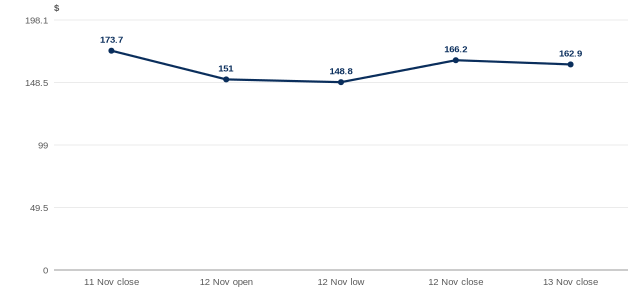
Finnhub market data via the daily packets, 12–13 Nov 2026.
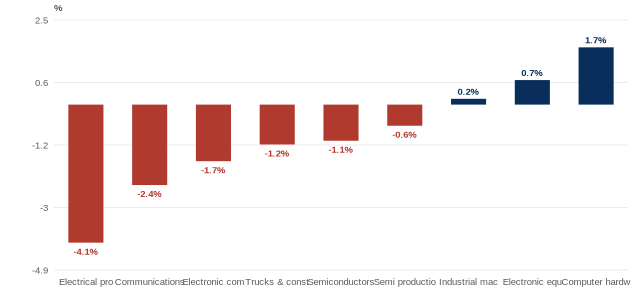
TradingView Japan sector/industry table, retrieved 15 Nov 2026 (latest session). Daily, not weekly, moves — shown as the format sample for the sector pack.
Part 2 — Coverage, capex and statistics
Semiconductors and AIDC — the prints
TSMC's October revenue of NT$586.89bn (+59.7% YoY) was its largest month on record, taking January–October revenue to NT$4,485.62bn (+43.3%). Applied Materials posted record Q4 revenue (+53% YoY) and Cisco record Q1 revenue (+24%) with FY27 guidance raised. In Japan, Japan Micronics' nine-month operating profit rose 138.9% YoY with guidance and the dividend raised, and Eblen's H1 operating profit rose 106% — evidence that HBM-related investment is reaching measurement and control equipment.
On the demand side, CoreWeave's Q3 revenue was $3.66bn (+168% YoY) with backlog of $132.5bn, but a net loss of $709M and interest expense of $846M; Nebius' Q3 revenue was $980.8M (+571%) while 2026 capex guidance rose to about $27bn and some third-party capacity slipped into H1 2027. Anthropic's Q3 compute and infrastructure spend was $9.9bn, 58% of its revenue. The constraint set — funding cost and delivery capacity, not end demand — is unchanged. Figure 2 puts the week's growth prints side by side.
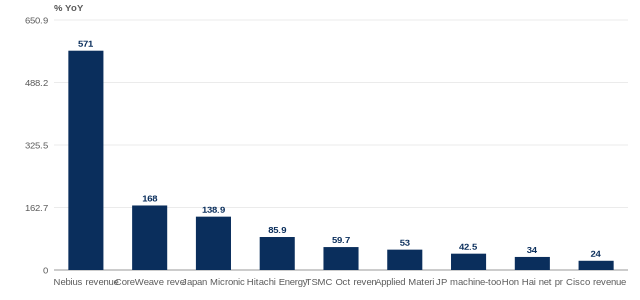
Company results, 10–14 Nov 2026. Each bar is the metric named in its label; metrics differ by company and are not directly comparable.
Power, machinery and factory automation
Siemens' Q4 orders of €34.77bn (+58%) were a record, led by smart infrastructure including data-centre electrical equipment, and its medium-term growth target was raised. Hitachi Energy India's Q2 (Jul–Sep) orders rose 85.9% to ₹41.21bn on revenue of ₹29.97bn (+63.6%), with backlog at a record ₹333.35bn — roughly 11x one quarter's revenue. GE Vernova won 765 kV transformer orders (70+ units) from India's POWERGRID, and India approved its first 1,150 kV project (₹68,816 crore, about six years).
Japan's October machine-tool orders were ¥204.4bn (+42.5% YoY), breaking the annual record in ten months. Amada raised its FY net profit forecast to ¥40bn (+31%) on AI data-centre sheet-metal demand; SMC raised its full-year recurring profit forecast by 36.0% with a buyback of up to ¥50bn; THK raised its net profit forecast to ¥58.8bn; Takasago Thermal raised its operating profit forecast 20% to ¥60bn with an orders forecast of ¥620bn for the first time. On 14 Nov, Infineon announced supply of the first 900V GaN bidirectional switch to Enphase for solid-state transformers — the power-semiconductor layer of the same AIDC power chain.
Capex, trade and demand statistics
The statistics tracker (Figure 5) is the fixed panel for this report: country capex, trade flows (imports, exports), shipments and demand indicators, read together rather than as isolated releases. This week it shows a consistent picture — US inflation sticky at the producer level, Chinese foundry utilisation at 97.3% (SMIC Q3 revenue a record $3.19bn), hyperscaler-linked capex guidance still rising (Nebius), and capacity being pulled forward where it is scarce (Samsung's HBM packaging plant, one year earlier to June 2028; investment amount 未取得).
GlobalFoundries' Q3 gross margin was a record 31.4% and its 2026 silicon-photonics outlook was raised to $500M — a data point for the optical/CPO theme that now sits in this report's coverage. ams OSRAM was the week's counter-example: Q3 sales of €829M and €3.8bn of cumulative design wins, but shares down 9.2% on disappointing Q4 guidance.
| Indicator | Latest | Source / date |
|---|---|---|
| US CPI | +0.4% MoM (consensus +0.3%); core +0.3% | BLS, 10 Nov |
| US PPI | +0.3% MoM; +6.5% YoY | BLS, 13 Nov |
| Hyperscaler-linked capex | Nebius 2026 guide raised to about $27bn | Company, 12 Nov |
| Foundry utilisation (China) | SMIC 97.3% | Company Q3, 13 Nov |
| HBM packaging capacity | Samsung plant pulled forward to Jun 2028 | Digitimes, 12 Nov |
| China AI accelerator share | Domestic makers passed Nvidia; Ascend 28% | Industry data via noon packet, 14 Nov |
| Weekly sector matrix (US/CN/TW/KR/EU) | 未取得 in this test run | Standard pack from next edition |
Official statistics and company guidance via the daily packets, 10–14 Nov 2026.
Part 3 — Catalysts and the week ahead
Catalyst attribution — why it moved, why it happened
Figure 6 lists the events that actually drove the week's performance, with the mechanism in each case. Two patterns matter. First, the largest single-stock move (Nvidia) was a governance event, not a demand event — the announcement came because a board investigation into the founder's conduct left no alternative, and the price fell on succession uncertainty (no designated No. 2, a CFO as interim CEO) rather than on any change to orders or guidance. Second, the sector-level moves were expectation trades: hot CPI and PPI prints moved the discount rate, and the same names that had been bought on prints early in the week were sold on macro by Friday.
| Date | Catalyst | Why it moved | Why it happened |
|---|---|---|---|
| 10 Nov | US Oct CPI hot (+0.4% MoM) | Rates headwind for growth names all week | Inflation still sticky above consensus |
| 10 Nov | TSMC record Oct revenue | Confirmed AI demand in volumes | Advanced-node and packaging demand |
| 11 Nov | CoreWeave Q3; SOX +5.66% | Rotation into AI infrastructure names | Backlog $132.5bn beat funding fears |
| 12 Nov | Nvidia CEO resignation | NVDA -13.1% open, -4.34% close; rotation to AMD/Broadcom | Board investigation into the founder; no designated successor |
| 12 Nov | Siemens / Hon Hai / Hitachi Energy India prints | Power and server breadth confirmed | Data-centre orders across grids and servers |
| 13 Nov | US Oct PPI +6.5% YoY | SOX -3.4%, AMD -8.8% — rotation unwound | Fastest producer-price rise since Nov 2022 |
| 14 Nov | THK / Takasago guidance raises; ams OSRAM -9.2% | Stock-specific: guidance, not sector, set the moves | FA/HVAC demand vs a weak Q4 guide |
Daily packets and company announcements, 10–14 Nov 2026.
Week ahead — 16 to 22 November
Monday 16 Nov: Japan's Q3 GDP first estimate — the split between domestic demand and capex is the read. Tuesday 17 Nov (US time; Wednesday morning JST): Nvidia's Q3 results — company guidance is revenue of $108bn ±2% against consensus of about $111.4bn; the form of guidance under the interim CEO and any comment on funding commitments matter as much as the print. Wednesday 18 Nov: FOMC minutes, and the requested closed-door congressional briefing on the Huang matter. Thursday 19 Nov: Japan's machinery orders. Each of these maps to a tracker in Figure 5; next week's edition will score them against the expectations recorded here.
Idea candidates — for the reader's judgement
Candidates only; the analysis and any decision sit with the reader. (1) Power-equipment breadth: orders at Siemens, Hitachi Energy and GE Vernova, plus record Japan machine-tool orders, against share prices that sold off with the semiconductor complex on 13–14 Nov — variant perception to test: whether the market is pricing power equipment as a derivative of the chip trade rather than on its own backlog (about 2.8 years of revenue at Hitachi Energy India). Catalyst: Nvidia's print and any hyperscaler capex commentary. Kill condition: order cancellations or lead-time compression in the next prints. (2) Nvidia succession discount: the shares closed the week about 36% below the October high with demand indicators (TSMC, backlog data) still rising — the question is whether the discount is governance-only and therefore closable by a credible succession plan at the 17 Nov print. Risk: the congressional process on 18 Nov extends the overhang.
The analyst named above certifies that they do not hold securities of the subject companies as of the date of this report. TEST RUN — prepared to test the Weekly Market Report format in the Research Report Editor; not investment advice and not for distribution.